
Real vs. Ideal: Dukkha in the Startup Trenches

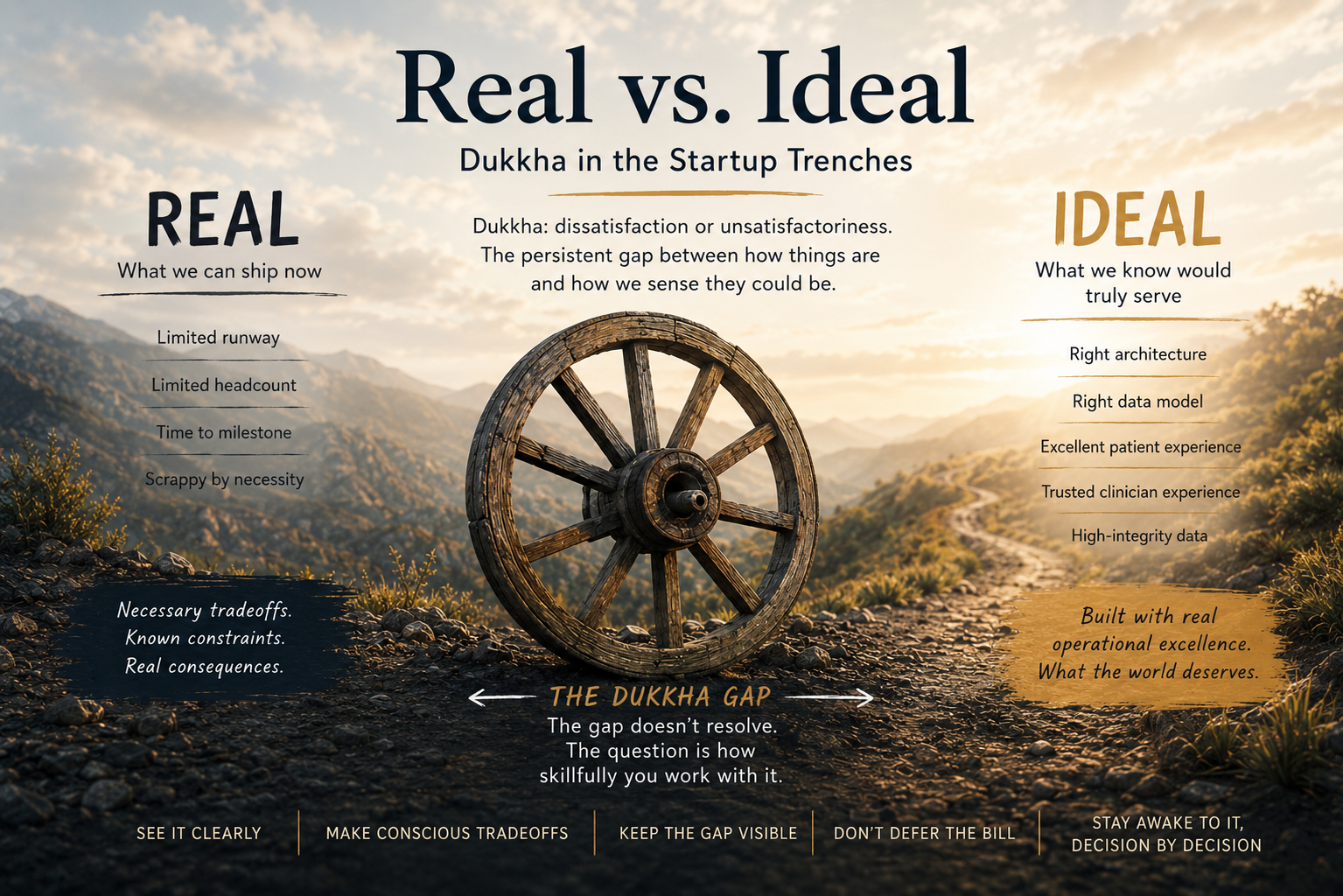
Dukkha is a Buddhist term, usually translated as suffering. That's fair. It's real suffering, not some mild inconvenience. But a fuller translation that I've heard is dissatisfaction or unsatisfactoriness: the persistent gap between how things are and how we sense they could be. The image of a wheel slightly off its axle is sometimes used. Most of the time you barely feel it. Sometimes the whole cart shudders.
I keep coming back to that idea alongside a phrase I use constantly with the startups that I mentor: Real vs. Ideal.
Most early-stage companies live in the dukkha gap. In the health tech companies I work with, Ideal is the product built with real operational excellence behind it: the right architecture, the right data model, actual thought given to how a patient, a clinician, or a piece of real-world data moves through the system. Real is whatever the team can ship given the runway, the headcount, what the investors want, and the clock running down to the next milestone.
That gap isn't a flaw. It's the condition every startup operates under, and Real falling short of Ideal is expected. The real problem starts when the company stops noticing the difference. You don't solve dukkha once. It's a constant baseline, and the real question is how skillfully you work with it.
I've coached executives for whom this is anything but abstract. They often see Ideal clearly, sometimes more clearly than anyone else in the room, and circumstances force them to build Real anyway. That mismatch wears on people. I've watched it show up as frustration, as low-grade grief, occasionally as burnout.
I know that tension personally. I've spent most of my career pulled toward Ideal, and I've struggled plenty when circumstances forced Real instead. What changed over time is that I stopped treating Real as a failure. Sometimes it's just the right call for that moment.
Where the gap starts eating the company
I've been a startup exec myself, and a founder, and over the years I've worked with dozens of executives and teams wrestling with this same tension. Most of my time these days goes into consulting, sitting with startup execs as they work through some version of this tension in real time. It comes up constantly, especially with employees who joined because they believed in Ideal and are now watching Real quietly become the whole story, with no end in sight.
The pattern repeats. A team knows what good looks like. Nobody's confused about long-term strategy. But the milestone in front of them starts to feel existential, and existential pressure has a way of turning strategy into whatever tactic clears the bar in front of you.
This is where "scrappy" earns its keep. Fiscal discipline, speed, duct-taping something together instead of waiting for the perfect build can be genuinely useful, especially early on. But "scrappy" also becomes a permission slip. It lets a team skip the operational excellence lens on a decision that deserved one. In health tech, those skipped decisions eventually land on someone: the patient, the clinician, or the integrity of the real-world data the company will eventually need to prove any of this worked. None of that shows up on this quarter's dashboard. It shows up eighteen months later: churn, clinician distrust, a dataset too messy to support the outcomes claim you need for a payer.
I've also seen the opposite problem: founders who treat operational excellence as a luxury, something you earn once you're big enough. It's its own trap, showing up as a tolerance for burning bridges, internally and externally, because whatever's next always feels more urgent than the relationship being spent to get there. Bridges are cheap to burn and expensive to rebuild.
And there's a subtle danger underneath both of these and it's the one I watch for most. A company gets comfortable with Real. Scrappiness works, the milestone gets hit, and the win starts to feel like proof that the compromise wasn't really a compromise at all. Eventually it gets touted as secret sauce, even as culture. Once a team gets used to Real, the pull toward Ideal fades, and it gets harder to reach back for it later, even once the money and headcount would allow it. That pull has to be maintained on purpose. Left alone, a company just settles into Real and calls it done.
Holding the gap instead of resolving it
The Buddhist response to dukkha isn't to pretend the gap isn't there. It begins by seeing it clearly and changing our relationship to it rather than being controlled by it.
This move is the one I bring to the startups I work with, over and over. The tension between Real and Ideal doesn't resolve. Nobody graduates out of it at Series B. What changes is whether the team is making its tradeoffs on purpose or by default.
I ask teams to just say the quiet part out loud. We know the right architecture handles this data model correctly. We're choosing the faster path because we've got four months of runway. Here's the debt we're taking on, and here's when we'll pay it down. Compare that to "we're scrappy, so we didn't think about it," and you've got the difference between dukkha held skillfully and dukkha ignored. Ignoring it doesn't make it go away. It just defers the bill to a future team, a future patient, or a future clinician.
The mantra isn't a resolution
I don't use Real vs. Ideal to help teams pick a side. I use it to keep the gap visible. The moment a startup stops seeing the distance between what it's building and what it knows would actually serve the patient, the clinician, the partner, operational excellence quietly becomes optional. Nobody notices until the damage is already done.
Dukkha shows up in the strategy deck as much as in the boardroom. The work was never making it go away. It's staying awake to it, decision by decision, and accepting Real for what it is right now without ever mistaking it for where you're headed.